SEO can take a few days to start working for a local business on Google Maps, but the bigger gains usually build over a few months. On Google Maps and Google Search in the UK, as of October 2026, profile edits, web pages and reviews run on separate clocks. In IvI SEO's York test, 3 of 4 map rank checks were up 4 days after a profile change, and 5 of 6 by 22 September 2026, alongside the website's new matching service pages.
Most answers to "how long does local SEO take?" give you one range, and that range hides the stages.
- Profile edits: An edit to a Google Business Profile is usually reviewed within 10 minutes, though sometimes it takes up to 30 days.
- Map rankings after a profile change: Google Maps rankings can start to move within days of a Google Business Profile change, but early readings go both ways. In the York test, "electrician near me" on the Wigginton grid got worse 4 days after the change (average rank 10.80 to 12.74, and lower is better).
- Website pages: A changed web page only counts once Google has crawled it again, which can take a few days to a few weeks.
- Reviews: Google reviews build up over months, because they come in one job at a time from asking every customer.
- The bigger gains: The bigger map gains take longer than the first movement. Across the six York map rank checks repeated on the same settings, the number of map points where the business didn't make the top 20 fell from 91 to 1 by 22 September, alongside the website's new matching service pages and two new reviews.
How quickly can Google Business Profile changes move your Google Maps ranking?
Google Business Profile changes can move your Google Maps ranking within days, once they've passed Google's review and gone live. Edits to a verified Google Business Profile usually take up to 10 minutes to review, but sometimes up to 30 days. An edit going live and the ranking reacting are two separate waits. When IvI SEO rewrote a York electrician's service descriptions on 5 June 2026, "emergency electrician wigginton" went from 13 to 19 of 35 top-3 points within four days, while "electrician near me" slipped and the website was gaining matching service pages.
Here's the honest answer to "how long does it take to rank on Google Maps" after a profile change: the first movement can show within days. One reading doesn't tell you how long SEO takes to work on the map, though. It tells you where you stood on the day you scanned.
The readings below come from Local Falcon, a rank grid tool. It runs your search from a grid of points across the map and shows where the business ranks at each point. Each number is the rank from that spot, so lower is better. A 1, 2 or 3 means the business is in the map pack, the three results people actually see.
Here's "emergency electrician wigginton" on 2 June, three days before the York electrician's descriptions went in:
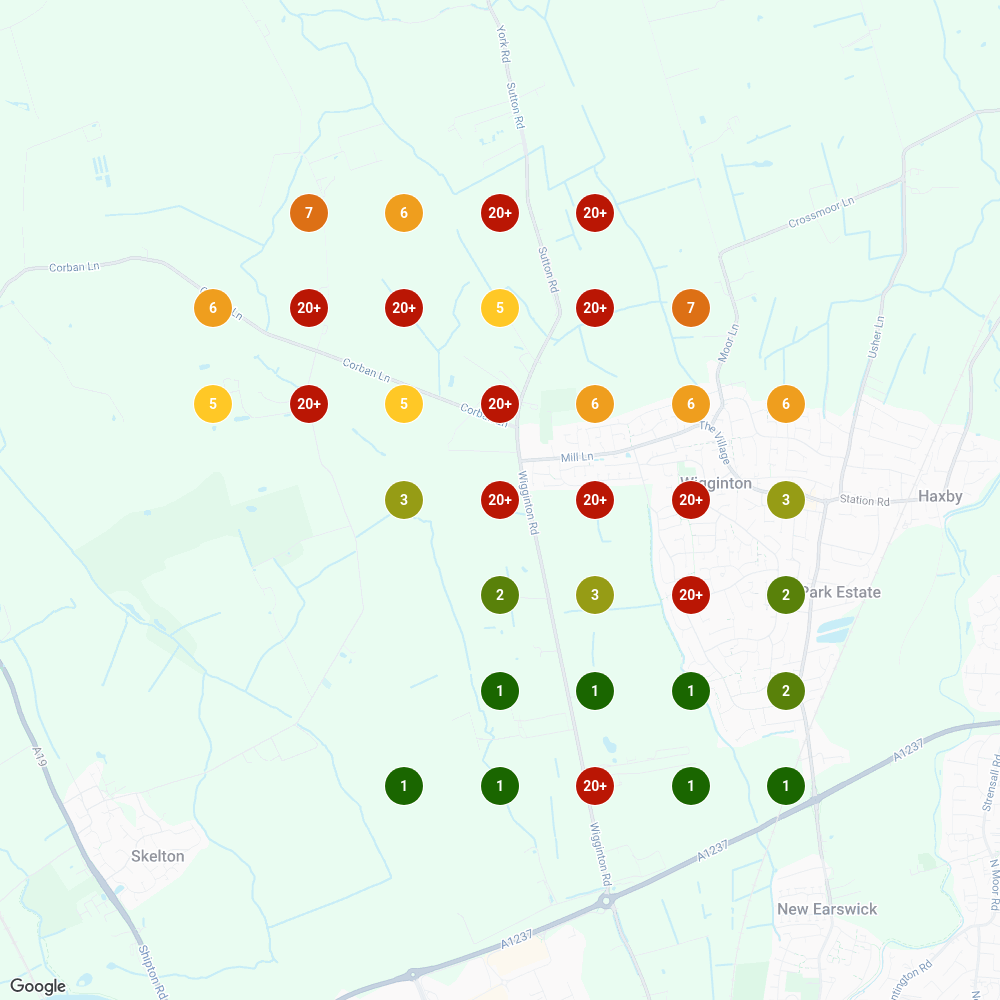
On 9 June, four days after the change, all four Wigginton grids were scanned again with identical settings. Each was a 7×7 grid reaching 1 mile from its centre in Wigginton.
| Keyword (7×7, 1.0mi) | Points in the top 3 (2 → 9 June) | Points outside the top 20 (2 → 9 June) | Average rank (2 → 9 June) |
|---|---|---|---|
| emergency electrician wigginton | 13 → 19 of 35 | 12 → 0 | 9.51 → 3.11 |
| electrician wigginton | 9 → 14 of 35 | 0 → 0 | 4.11 → 3.29 |
| house rewire wigginton | 0 → 0 of 35 | 31 → 0 | 19.17 → 5.00 |
| electrician near me | 0 → 0 of 35 | 0 → 7 | 10.80 → 12.74 |
Average rank is Local Falcon's average position across all 35 points, with "not found" counted as 21.
The same emergency grid on 9 June had no points left outside the top 20:
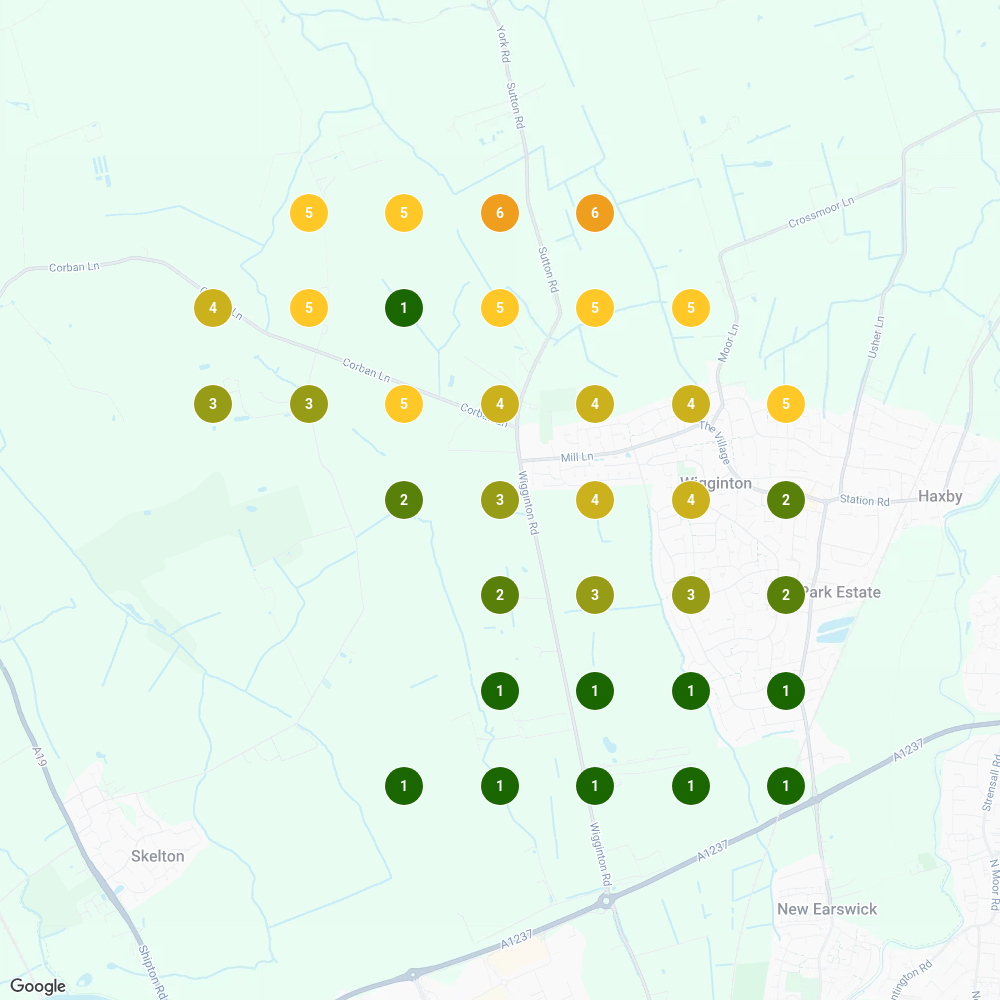
Look across the rows and it's not all good news. "House rewire wigginton" still didn't reach the top 3 at any point. It did go from missing at 31 points to showing up inside the top 20 at every one. "Electrician near me" went the other way. It dropped out of the top 20 at 7 points, and its average rank got worse. That's the same area over the same four days, with the opposite result.
Early scans are early. This is one business, one profile and one reading taken four days in, and it isn't proof the descriptions did it. The descriptions weren't the only change, either. Between June and September the website gained matching service pages and two new reviews came in (8 to 10). (I'd love to put the whole lot down to my descriptions. I can't.) Every scan, before and after, is in the full York case study.
All of this assumes the edit actually went live. An edit stuck in pending, or one that got rejected, hasn't reached the map yet. If nothing's moved, know which clock you're on before you read anything into a grid.
That's the fast clock. The website's clock runs slower.
How long does a new or changed web page take to show in Google?
A new or changed web page can take a few days to a few weeks to show in Google, because Google has to crawl it first. Crawling is Google visiting and reading a page. On a website, how long before SEO changes take effect depends on when Google next crawls the page, not on when you made the edit. Showing in Google isn't the same as ranking well, so "how long does it take to rank on Google" has a separate answer, which depends on the page and its competition. Google's recrawl guide says "Crawling can take anywhere from a few days to a few weeks", and the URL Inspection tool in Search Console shows a page's progress.
The website pages are still worth the work if you mainly want to show on the map, because a Google Business Profile doesn't work on its own. A profile and a website that say the same thing about the same services back each other up. The York electrician's website, for one, got a full set of service pages matching the profile over the same months as the description rewrite. That's why every York result above names those pages beside it.
You'll also hear the word "index". Indexing is Google adding a crawled page to its index, the huge store of pages it picks results from. Crawling is the visit and indexing is the filing, and only a page that's been filed can show up at all.
The wait applies to small fixes as well as new pages. If you fix a meta title (the clickable blue headline your page gets in the results), the old one keeps showing until Google comes back for another look. It's annoying when the old one has a typo you've only just spotted, but refreshing the results won't hurry it. (What goes in a good meta title is in the local meta titles guide.)
Being in Google is the start line, not the finish. A page that's indexed but never brings in an enquiry is just taking up room.
So what should you actually see while all of that catches up?
What should you see in the first few months of local SEO?
You'll usually see map rankings and profile views start to improve in the first few months of local SEO, though not in a straight line. Google's SEO Starter Guide says some changes might take effect in a few hours and others several months, and suggests waiting a few weeks before judging your work. The signs worth watching are calls, website enquiries, the Google Business Profile performance report and your map ranking across your area, checked monthly on a rank grid with the same settings each time. IvI SEO pulled a York electrician's profile report for August 2026: searches were up 221% and profile views up 98% on July, alongside the website's new matching service pages, but calls stayed at 3.
- A rank grid: A rank grid scanned once a month on the same settings shows how your map ranking is moving across your whole area, not just from wherever you happen to be standing (how to check your Google Maps rankings covers which settings to keep).
- The profile's performance report: The Google Business Profile performance report shows searches, profile views and website visits. For the York electrician in August 2026, that came to 559 searches, 1,023 profile views and 17 website visits (up 88% on July).
- Calls: Calls made straight from a Google Business Profile can stay flat while everything else rises (3 in August for the York electrician, the same as July).
- Website enquiries: GA4 (Google Analytics 4) counts enquiries on your website only from the day tracking starts. On the York site, GA4 counted 19 leads from all traffic between 24 July and 25 September 2026, with no earlier figure to compare them against.
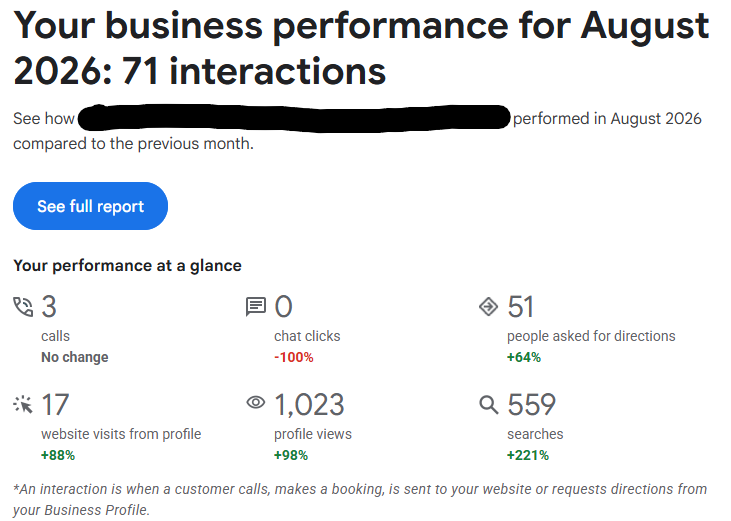
Here's how I read that report. Calls didn't budge, but website visits did. More people were clicking through to the website for a proper look instead of ringing straight off the profile. That's fine by me, because the website is where the York enquiries came in. A thousand-odd profile views look lovely in a screenshot, but views don't pay anyone's wages. Enquiries do.
It's one business, though. Those August numbers sit in the same months as the website's new matching service pages and the profile's two new reviews (8 to 10), so I can't credit any single change.
Don't judge it on one scan, either. Rank grids wobble even when nothing changes. The York electrician's grid for "emergency electrician haxby" was scanned on 8 and 22 September with nothing changed in between. The top 3 barely moved (48 points to 47), but first place dropped from 12 points to 4. Same profile, same grid, a fortnight apart. That's the wobble in the York scans, and it's why I'd trust a run of monthly readings over any one map.
Why does SEO take longer to work for some local businesses?
SEO takes longer to work for some local businesses because they face stronger competitors, sit further from searchers or have fewer reviews and links. Local results are mainly based on relevance, distance and prominence, meaning how well a business matches the search, how far it is from the searcher and how well-known it is. Prominence includes how many reviews a business has and how many websites link to it. Distance is fixed, but the other two factors aren't. Reviews and links build slowly, so a business that starts with few of them and faces plenty of competitors has further to climb.
Distance is also why progress tends to come area by area rather than all at once. Every searcher gets a slightly different map, depending on where they're standing. So a profile can sit in the top 3 for people round the corner and barely show for someone across town searching the same words. (What relevance, distance and prominence each mean, and what you can change about them, is in the guide to how Google ranks local businesses.)
The type of search matters too. This is my view from the York test I ran, not a law: the generic searches moved least. In Haxby, "electrician haxby" held at 27 of 49 points in the top 3 from 9 June to 22 September. Over the same dates, "house rewire haxby" went from 15 to 42 of 49. "Electrician near me" on the 0.8mi grid around Clifton went the wrong way between 2 June and 22 September, from 23 to 20 of 30. The searches that moved most were the service-specific ones the new service descriptions named. The website gained matching service pages over the same months and two new reviews came in (8 to 10), so I can't tell you which change did what.
One more thing worth ruling out is old or conflicting business details, like a previous phone number on a directory you forgot you ever joined. The post on NAP consistency (keeping your business name, address and phone number the same everywhere) covers what to check.
Slow isn't always broken. Some of it you can't change, and the rest you can start on sooner.
Can you speed up local SEO?
Yes, you can speed up local SEO a little by fixing what's wrong on your Google Business Profile first, because profile edits often go live within minutes. Start with verification and anything wrong, such as a dead phone number, an old address or a duplicate listing, then fill in what's missing, such as service descriptions. Ask every customer for a review, steadily, because reviews build over months. Nothing gets round distance, and there's no way to pay Google for a better local ranking. Under IvI SEO's wrong-before-untidy order, a wrong detail such as a duplicate listing is fixed before an untidy one like "St" against "Street", but the duplicate merge for two UK law firms in 2024 still took about 90 days and several follow-ups.
In the order I'd do them:
- Fix what's wrong first: Verification and wrong details on a Google Business Profile come before any tidying, because a dead phone number loses you a job today while "St" against "Street" loses you nothing (the full order is in the post on doing local SEO yourself).
- Fill in what's missing: Service descriptions on a Google Business Profile take minutes to write and most profiles leave them blank, which makes adding service descriptions one of the easiest gaps you'll ever close.
- Ask every customer for a review: A review request should go to every customer, every time, straight after the job, with nothing offered in return. A couple of new reviews a month does more than twenty in one week followed by months of nothing.
- Ask Google to recrawl a changed page: You can ask Google to crawl a changed web page again through the URL Inspection tool in Search Console, or submit a sitemap when lots of pages have changed, though the crawl itself can still take a few days to a few weeks.
- What to avoid: Anyone who tells you exactly how long SEO takes to work for your business, promises first place or offers a way to pay Google for a higher spot on the map is overselling. There's no way to request or pay for a better local ranking on Google, and nobody can honestly guarantee rankings or calls, IvI SEO included.
The catch is that fixing something wrong isn't always quick. In 2024 a takeover turned two UK law firms into one, and the closed office's profile needed merging into the one that stayed. IvI SEO sent Google Business Profile support the proof (the website, the location, legal documents), then followed up, then followed up again. About 90 days later it went through, and every review came across. That's one case, not a Google figure. If you're facing one, read how that merge went, step by step before you start.
Everything else on that list is little and often: the review request after every job, the detail fixed the day it changes. None of it is hard. Keeping it going is.
Can someone else keep your local SEO going while it builds?
Yes, someone else can keep your local SEO going while it builds, because most of the work is steady jobs done little and often. IvI SEO's local SEO service takes on the jobs an owner could do themselves: the Google Business Profile, service pages, consistent business details, review requests and reporting tied to enquiries. IvI SEO doesn't guarantee a fixed position or timeline, because nobody honestly can.
However long SEO takes to work for your business, the jobs are the same either way. What changes is whose list they sit on. Doing it yourself is a perfectly good choice: every step on this page is free to use, and nobody knows your customers better than you do. The catch is rarely the work itself. It's the review request that never goes out because the job finished at six on a Friday, or the monthly scan that quietly turns into a twice-a-year one.
Handing it over means those jobs sit on my list instead of yours and get done on the same steady rhythm, whether your phone's quiet or ringing off the hook. Same work, same order, just not eating into your Sunday evening. If that sounds like a weight off, hand the steady jobs to IvI SEO's local SEO service. If not, keep them on your own list.
Either way, keep the clocks running.